
Marketing Attribution Services: What B2B Firms Should Expect

Marketing attribution services tell you which campaigns, channels and touchpoints deserve credit for pipeline and revenue. For a B2B firm where one new client is worth $50K or more, the report is only as good as the data behind it and the team acting on it. That is why we run attribution inside a single growth department, where search, outreach, paid advertising and the data layer feed one set of numbers, instead of as a standalone dashboard bought on its own.
This guide covers what attribution can and cannot tell you, what a sound engagement looks like from onboarding to the first report, and which numbers to put in front of your partners or board.
TL;DR
- Attribution assigns revenue credit to marketing touchpoints across a buyer’s journey. In B2B it shows association, not proof of cause, so treat it as evidence for decisions rather than a verdict.
- Long cycles, several buyers per deal and sales-owned data make B2B attribution hard. Clean CRM and first-party data matter more than the choice of model.
- Own every account (analytics, ad platforms, CRM, domain) and give your provider removable, invited access.
- Report pipeline, opportunities and new revenue against cost, not cost per lead alone.
- Our setup is designed so the data layer, outreach, search and paid channels report into one view, with activation often within 24 hours.
Table of Contents
- What marketing attribution services actually do
- Why B2B journeys are harder to measure
- Choosing an attribution model without overthinking it
- The data foundation comes before the model
- What a good engagement looks like: onboarding to first report
- Reporting marketing ROI your leadership will trust
- Where attribution meets the rest of growth
- One growth department, one view
- Our perspective
- FAQ
- Sources
What marketing attribution services actually do
Attribution is the practice of assigning revenue credit to the marketing touchpoints in a prospect’s journey, from the first interaction through to the closed deal. The point is to see which campaigns and channels are worth more budget and which are not.
A service wrapped around that practice usually does four things:
- Connects the systems where buyer activity is recorded: CRM, website analytics, ad platforms, email and outreach tools.
- Defines the milestones you will measure, such as first touch, lead creation, opportunity creation and closed won.
- Applies a credit rule to those milestones.
- Reports the result in a form leadership can act on.
The third step gets the attention, but the first two decide whether the output is believable. A credit rule applied to a half-connected CRM produces a confident chart of the wrong thing.
There is also a plain limit worth stating early. Attribution reports which touchpoints sat near a won deal. It cannot, on its own, show that those touchpoints caused the win. A referral partner may have sent the buyer long before a LinkedIn ad appeared, and the report will still credit the ad. Good attribution work keeps that in view and uses tests and judgment alongside the model.
Why B2B journeys are harder to measure
If you sell engineering services, commercial construction, facility contracts or enterprise software, your buyer does not click once and purchase. BCG notes that B2B products are generally more complex and buying cycles longer, which makes revenue harder to attribute to marketing spend. Its suggested answer is to triangulate: combine tests, research and multi-touch models rather than lean on one.
Three features of your world make this sharper:
- Many people per deal. A principal, a project manager and a procurement lead may each touch different content on different weeks.
- Offline moments. A conference conversation, a phone call or a referral introduction rarely lands in an ad platform.
- Sales owns the bottom of the funnel. Gartner’s 2024 B2B CMO guide says marketers struggle to prove value when sales manages the late-stage work and does not consistently share tracking data.
That last point is the one firms that grew on referrals feel most. If your partners run relationships from their inboxes and phones, the most valuable part of the journey is invisible to any tool. Attribution work for you starts with getting those conversations recorded in the CRM, not with picking software.
Choosing an attribution model without overthinking it
The models differ in where they put the credit. Documentation for one major platform lists six common models: first touch, lead creation, U-shaped, W-shaped, full path and custom. It adds that the right choice depends on which stages matter to you and the data you have.
In plain terms:
| Model | Where credit goes | Fits when |
|---|---|---|
| First touch | The first recorded interaction | You want to know what creates awareness |
| Lead creation | The interaction that turned a visitor into a lead | Your priority is lead capture |
| U-shaped | First touch and lead creation, with the middle sharing less | You care about discovery and conversion moments |
| W-shaped | First touch, lead creation and opportunity creation | Your sales process has a clear opportunity stage |
| Full path | Every milestone through closed won | Cycles are long and the CRM is well kept |
| Custom | Weights you set | You have enough history to justify them |
For most established service firms, a W-shaped or full-path view is a sensible starting point, because it respects the opportunity stage where your sales team takes over. Salesforce also separates touch-based attribution, which measures interaction influence, from funnel-based attribution, which measures how prospects progress through lifecycle stages. A firm with a long consultative sale often needs both: touch credit to judge channels, funnel progression to find where deals stall.
BCG’s practical advice is worth keeping on the wall: favor a measurement process you can operate consistently over a theoretically perfect model that nobody maintains. A simple model reviewed every month beats a sophisticated one reviewed never.
The data foundation comes before the model
Salesforce describes first-party data, such as CRM records, form submissions and email engagement, as the more reliable base for attribution because you own it and it reflects real customer interactions. It also notes that the lookback window, the period over which earlier interactions can still earn credit, determines what the report can see. A six-month cycle measured with a 30-day window will quietly ignore the touchpoints that started the deal.
There is a wider reason to build on your own data. Gartner points out that third-party cookie deprecation and privacy expectations make the future of digital methods such as multi-touch attribution more uncertain. Tracking that depends on your own CRM and your own forms is sturdier than tracking that depends on browser behavior.
In practice the foundation means:
- Consistent lifecycle stages and opportunity definitions in the CRM.
- Company and contact records that are complete and de-duplicated, so activity attaches to the right account. Our guide to sales intelligence data covers the types and sources.
- CRM and marketing tools connected, which is the subject of our note on CRM integration consulting.
- Source fields captured at the moment a lead is created, not reconstructed later.
This is the work our data layer service sits on: prospect and company data enrichment that gives prioritization and attribution decisions something firm to stand on.
What a good engagement looks like: onboarding to first report
The questions people type around this topic, such as how agency onboarding works and how long implementation takes, have the same answer: it depends on how ready your data is. The sequence below is what a sound engagement tends to include. It is a planning guide, not a promise about any provider’s schedule.
Before kickoff: what you prepare
Bring a one-sentence statement of the first decision you want the data to inform, for example whether to move budget from paid social to outbound. Then gather:
- Business goals and your ideal client profile.
- Lifecycle and opportunity definitions, and who owns each stage.
- Budget boundaries and who approves spend and creative.
- Prior campaign and funnel history, and the data gaps you already know about.
- Access to the CRM, analytics, tag management and ad platforms.
Onboarding guidance from agency practitioners agrees on this shape: scope, goals, funnel definitions, reporting cadence, owners and baselines are settled first, then the existing tracking is audited and the attribution rules are agreed.
Keep ownership of your accounts
Create and own your analytics property, tag manager, ad accounts, CRM and domain registration yourself, and grant your provider invited, removable access. If a provider owns the accounts, ending the relationship can mean losing your ad history and analytics data. This applies to any provider, including us, and a good one will ask for access in exactly this way.
Setup and validation
Setup covers connecting the tools, defining the events and milestones, and making sure source information is captured on every new lead. Validation is the part buyers underestimate. Before anyone makes a budget decision, check that:
- Events fire and reach the CRM.
- Records match the right accounts.
- Revenue in the attribution view reconciles to revenue in finance.
A successful data upload proves only that data was delivered. It says nothing yet about whether credit is assigned sensibly. When the CRM, the attribution report and the ad platforms disagree, which they will, the useful step is to explain why they differ, not to force the totals to match.
As a rule of thumb, allow a period of weeks, not days, between kickoff and numbers you would spend against, and revisit the setup whenever you add a channel or tracking conditions change. Our own approach is built to shorten the front end: we aim to activate services often within 24 hours, so that data starts accumulating while the deeper validation runs.
The first cycles
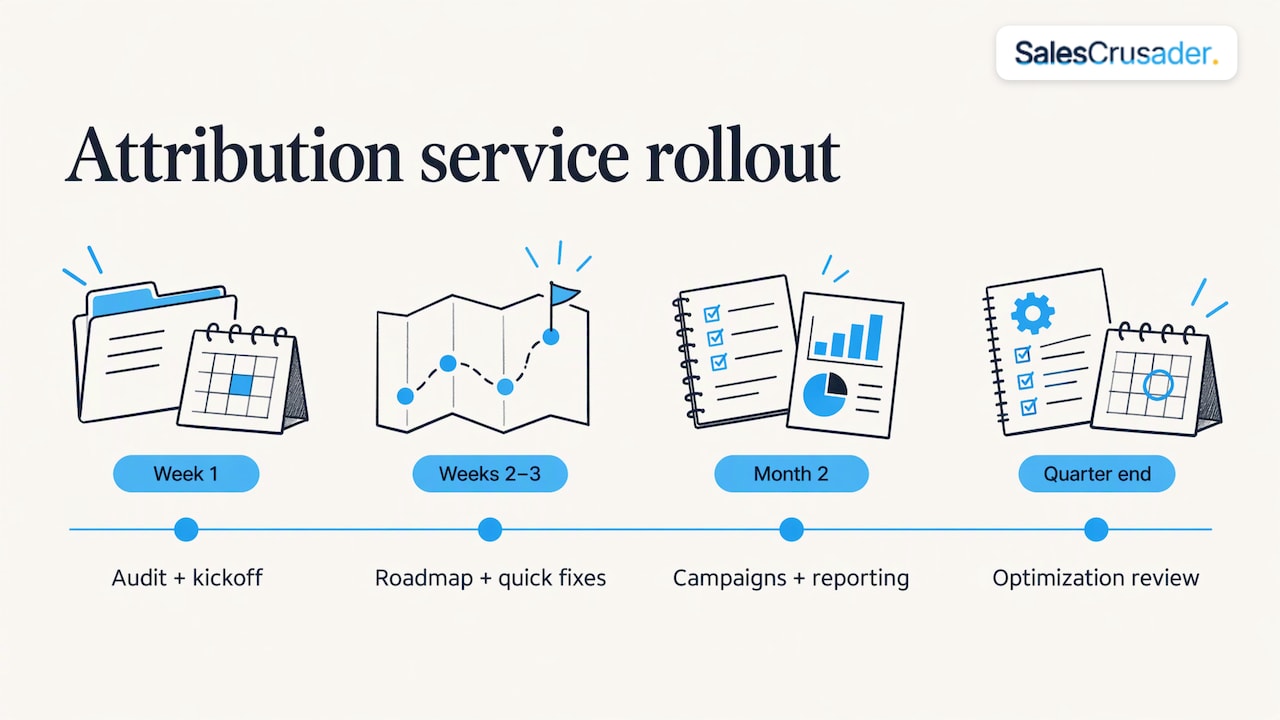
A workable pattern is an audit and kickoff in the first week, a roadmap and quick fixes over the next two, a first full cycle of campaigns and reporting through the second month, and an optimization review as the quarter closes. Because long sales cycles mean closed-won results trail activity by months, early reports should lean on leading measures: opportunities created, meetings booked with target accounts, pipeline value.
Reporting marketing ROI your leadership will trust
Leadership asks one question: what did we get for what we spent? Answer with measures tied to pipeline and revenue, not activity.
A solid report includes:
- Pipeline generated and opportunities created, by channel and by source.
- New-client revenue, and its cost relative to marketing spend.
- Cost per opportunity and cost per dollar of pipeline.
- Win rate by channel or source.
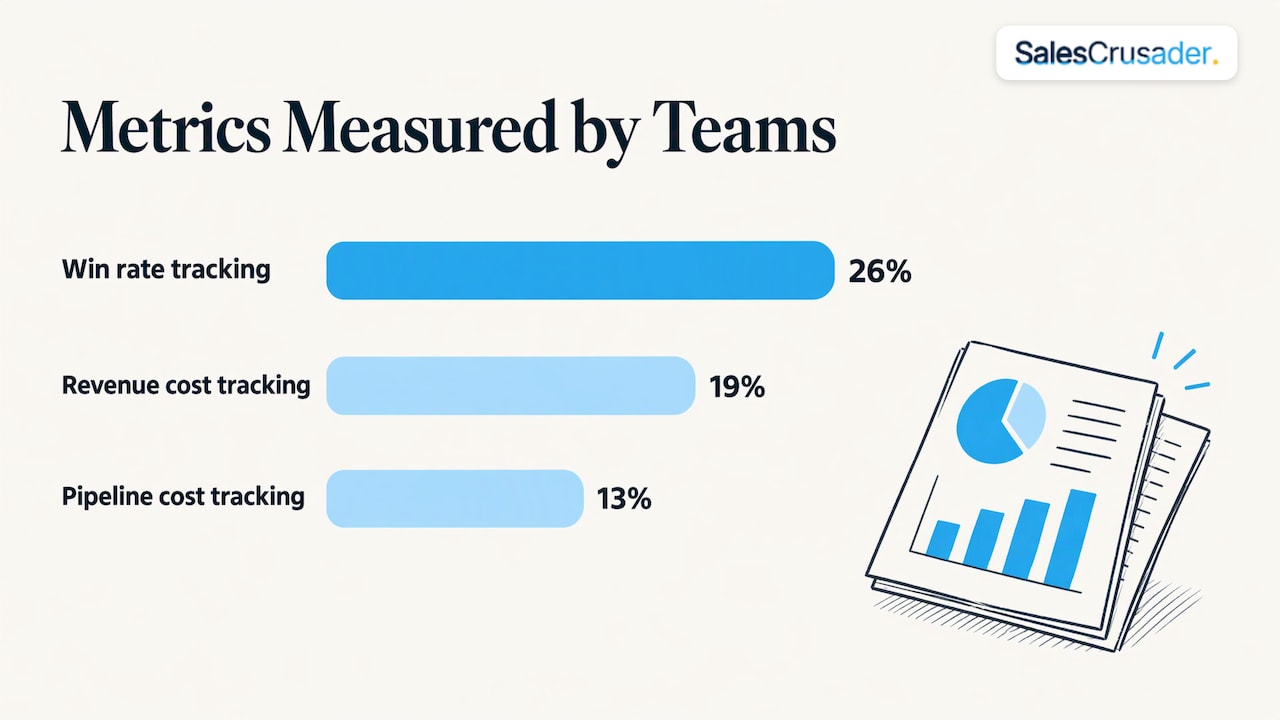
Most teams measure less than they think. A 2022 benchmarking study of 311 respondents from LeanData and Salesforce found that 26% measured win rate by channel or source, 19% measured cost per dollar of revenue and 13% measured cost per dollar of pipeline. The same study cautions that cost per lead in isolation can mislead when leads are not followed through to closed-won revenue. For a firm whose deal is worth $50K, a cheap lead that never reaches a proposal is not cheap.
A simple worked example. Say a quarter’s marketing spend is $30,000. It produces 12 opportunities worth $600,000 in pipeline, and two close for $120,000. Cost per opportunity is $2,500. Cost per dollar of pipeline is $0.05. Cost per dollar of new revenue is $0.25. Each figure answers a different question, and none of them depends on how many form fills you collected.
Finish every report with the caveats that keep it honest: the lookback window used, the model applied, the share of deals with a recorded source, and which deals began with a referral or offline conversation. Before a large budget shift between channels, look for stronger evidence than a credit report, such as a holdout test or a deliberate pause in one channel.
Where attribution meets the rest of growth
Attribution only earns its fee when it changes what you do. That is why the growth marketing process matters more than the report. A monthly loop that works for most firms:
- Review pipeline and opportunity movement by channel.
- Pick one or two decisions the data supports: fund, fix or stop.
- Change the campaigns, site or outreach sequences accordingly.
- Record the decision and the reasoning, so next quarter’s review has a baseline.
The channels in that loop are the ones we run. Search and AI discovery work on how buyers find you in search and answer engines. Multichannel outreach and LinkedIn outreach handle direct conversations with target accounts. Paid lead generation and LinkedIn ads add reach. If leaks appear after the lead stage, sales funnel optimization and sales analytics show where deals stall.
When one team runs all of these, the attribution question and the action question sit in the same room. Nobody has to translate between an analytics vendor, an ad agency and an outreach contractor before a decision gets made.
One growth department, one view
Sales Crusader acts as an outsourced growth department for B2B firms that have outgrown referrals. We combine search and AI visibility, multichannel outreach, paid advertising, conversion-focused web design and a data layer, with reporting and benchmarking across all of them. Human strategy is supported by AI agents, so implementation and measurement move quickly without you hiring new staff.
Our data layer is built to give you actionable evidence for prioritization and attribution, and it works alongside the channels it measures. If you also want to run outreach in-house, our platform offers LinkedIn multi-sender, AI reply classification, engagement de-anonymization and CRM integrations.

To see how the pieces fit together for a firm like yours, start with our growth services overview.
Our perspective
Most firms that come to us do not have an attribution problem. They have a visibility problem that shows up as one. Referrals fill the pipeline, nobody can say what else works, and the first attempt at measurement is a dashboard that credits whatever was clicked last.
We think the fix is to build the evidence while the work is running. When search, outreach, paid and the data layer sit under one team, every campaign is set up to record its source, every reply is classified, and every meeting lands in the CRM with its origin attached. The report is then a by-product of the work rather than a separate project.
We also think honesty about limits makes a report more useful. Credit models show association. Pair them with a clear decision, a record of why you chose it and, where the stakes are large, a test. That is how a leadership team ends up trusting the numbers.
Our positioning is simple: one outsourced growth department, activated quickly, measured in one place, with you keeping ownership of your accounts and your data.
Rory
FAQ
How long does it take to get reliable attribution data?
Allow weeks for setup and validation, then more time for closed-won results to accumulate, since B2B cycles run for months. Early reports should focus on opportunities and pipeline. Models also need adjusting when you add channels or tracking conditions change.
What access do I need to give a provider?
Give invited, removable access to your CRM, marketing automation, analytics, tag management and ad platforms, and keep the accounts in your own name. Share lifecycle definitions and budget approvers too, so the provider knows what counts as a valuable outcome.
Which metrics should I report to leadership?
Pipeline generated, opportunities created, new-client revenue, cost per opportunity, cost per dollar of pipeline and win rate by source. Cost per lead alone can mislead when leads are not tracked through to closed-won revenue.
Is multi-touch attribution still worth using?
Yes, as one input. Gartner says privacy rules and cookie changes make digital methods less certain, so build on first-party CRM data and compare the model against tests and your own sales knowledge before moving large budgets.
Sources
- Marketing Attribution, Adobe Marketo Measure documentation
- Attribution in Marketing Intelligence, Salesforce Help
- The B2B CMO’s Guide to Marketing Attribution and Testing, Gartner
- Building Bionic Capabilities for B2B Marketing, BCG
- Agency Onboarding Checklist for SaaS Teams
- 2022 Inbound and Outbound Sales Pipeline Performance Benchmarking Report, LeanData and Salesforce