
Google Ads Management for B2B: Strategy, Pricing, Tracking
Google Ads management for B2B means running paid search against a small buying group, a long sales cycle and deals worth tens of thousands of dollars, then judging it by booked meetings and pipeline rather than clicks. It works best when it is not a stand-alone channel. At Sales Crusader, paid advertising sits next to search, outreach, website conversion and a data layer, so the same team sees what a click turned into.
TL;DR
- B2B Google Ads succeeds on intent and account quality, not volume: budget goes to commercial and decision-stage searches, with one objective per campaign.
- Tracking decides everything. If closed-won and sales-accepted deals never flow back into Google Ads, the algorithm optimizes for form fills, not buyers.
- Agencies charge by percentage of spend, flat retainer, performance fees or a hybrid. Each model rewards different behavior, so match it to your spend and sales cycle.
- Paid search performs better when the landing page, outreach and CRM data are handled together. That is how we run it.
Table of Contents
- What makes B2B Google Ads different
- Building a B2B paid search strategy
- Tracking: where most B2B accounts fail
- How agencies price Google Ads management
- What to expect from a management service
- Why paid search belongs with the rest of your growth work
- Perspective
- Want paid search tied to booked meetings?
- FAQ
- Sources
What makes B2B Google Ads different
A consumer campaign can win on thousands of cheap conversions. A B2B campaign for an engineering firm, a facility services contractor or an infrastructure software company might need five qualified conversations a month, and each one is worth a great deal. Search volume is small, clicks are expensive, and the person who searches is rarely the person who signs.
Google’s own B2B funnel guide notes that search ads can capture high-intent traffic at each funnel stage, that Keyword Planner shows search volume, competition and bid costs, and that audiences can be segmented by the companies potential buyers work for. The practical meaning: you can aim at a defined list of accounts and at the moment they are actively looking, instead of paying to educate everyone.
Three features separate B2B management from consumer management:
- Small data. You may see 30 conversions a month, not 3,000. Every wasted click matters, and automated bidding has less to learn from.
- A buying committee. The operations manager searches, the CFO approves, procurement negotiates. One campaign rarely reaches all three.
- A long gap between click and revenue. A lead from March may close in September. Reporting that stops at the form fill misses the point.
Building a B2B paid search strategy
Start with the searches that signal a purchase
For a firm winning $50K+ clients, the money is in commercial searches: a service plus a location, a vendor comparison, an “alternatives” query, a request for a quote or demo. Informational searches (“what is commissioning”) bring readers, not buyers, and are usually better served by content and search optimization than by paid clicks.
Build the keyword list from the sales team’s language, not only from tools. Ask what prospects typed or said before they became clients, then validate volume and bid ranges in Keyword Planner. Add negative keywords early: job seekers, students, free tools, and consumer meanings of your terms.
Structure campaigns around one objective
Google’s account setup best practices say automated bidding is objective-based, so a campaign should generally have a single objective. They also advise avoiding budget-limited campaigns, using Maximize conversions or Maximize conversion value when you have a daily budget goal, uploading first-party audience lists, and pairing Smart Bidding with broad match keywords and responsive search ads.
In B2B this translates into a simple layout:
- High-intent service campaign. Your core commercial terms, sending traffic to a page built for one offer.
- Competitor and alternative campaign. Kept separate so budget and messaging can be controlled.
- Retargeting. Audiences who visited pricing, service or case study pages and did not book.
- Account-targeted layer. Your target-account list as an audience, used to adjust bids and messaging.
Broad match with automated bidding is only safe when the conversion signal is good. With a weak signal, broad match spends your budget finding cheap, unqualified form fills. That is why the next section matters more than any keyword tactic.
Use your target-account list as an audience
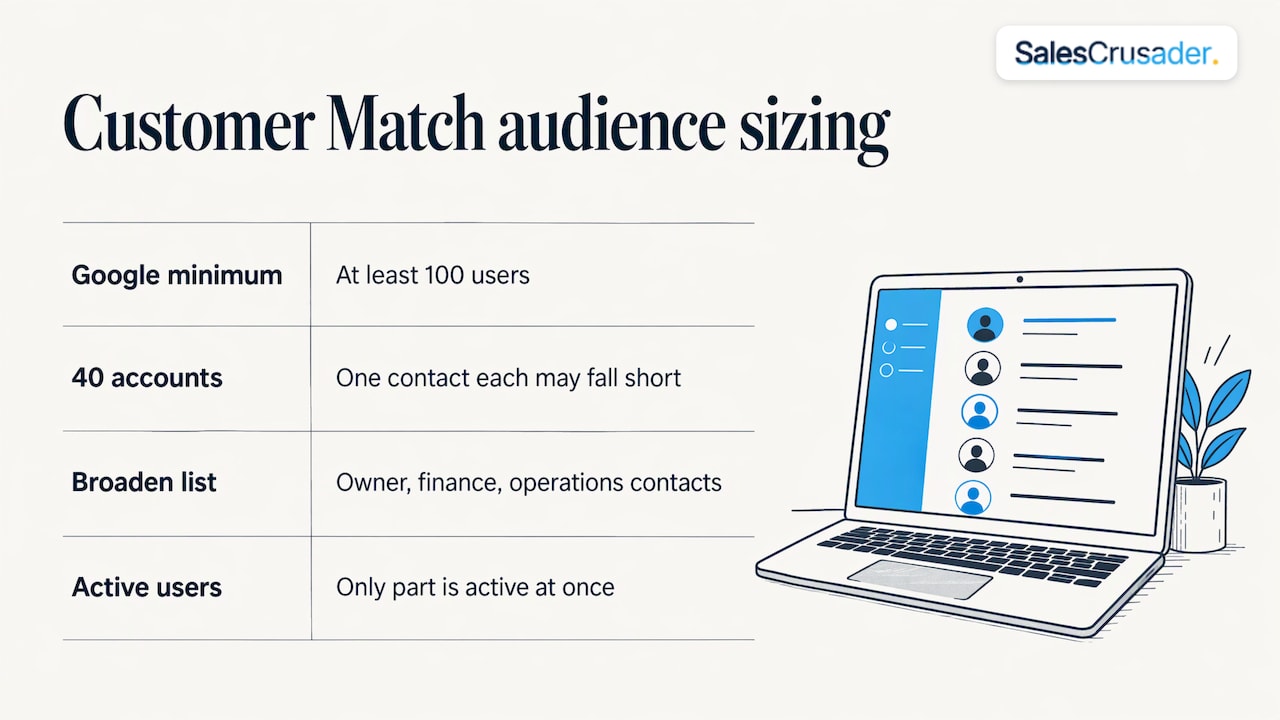
Customer Match lets you upload first-party contact lists to Google Ads. Google recommends lists of at least 100 users so ads can serve, and only part of a list is typically active at any moment, because not everyone is signed in. A list of 40 target companies with one contact each will not do much. Widening each account to several roles (an owner, a finance lead, an operations lead) gives the audience enough size, and it mirrors the real buying group.
This is where a data layer pays off. Clean, enriched contact and company records are the raw material of every audience. Our data layer is built for exactly that, and the same records feed outreach, so the people who see your ads can also receive a direct message.
Send clicks to a page that converts
A B2B visitor comparing three firms wants proof fast: relevant projects, named clients, a clear next step. A generic homepage wastes the click. Match each campaign to a page with one offer and one action, and keep forms short enough that a busy executive finishes them. Our guide on generating leads from your website covers the page-level fixes, and conversion-focused website design is part of what we do.
Tracking: where most B2B accounts fail
Google can only optimize toward what it is told. If the conversion is “form submitted,” it will find more people who submit forms, including students, vendors and competitors. The fix is to feed back what sales actually experiences.
The working pattern:
- Capture the click identifier (the GCLID, a unique ID Google appends to the landing URL) in a hidden form field.
- Store it on the lead or contact record in your CRM and never overwrite it.
- When a lead becomes sales-accepted, an opportunity or a won deal, import that event back into Google Ads as an offline conversion.
Timing is the trap. Google’s offline conversion guidelines state that conversions uploaded more than 90 days after the associated last click are not imported, and the limit is 63 days for enhanced conversions for leads. If your sales cycle runs six months, the closed-won event will arrive too late. Import an earlier milestone instead, such as a sales-accepted lead or a qualified opportunity, and judge revenue in your CRM.
Then choose metrics that match the business, not the platform:
| Metric | Why it matters |
|---|---|
| Cost per qualified opportunity | Shows what a real sales conversation costs |
| Meeting-booked rate from paid traffic | Tests whether the landing page and offer work |
| Pipeline value by campaign | Connects spend to revenue potential |
| Share of target accounts reached | Shows whether ads are hitting the right companies |
| Cost per click and click-through rate | Diagnostic only, never the goal |
A CPC that looks painful can be fine if two in ten clicks from the right accounts become meetings. A cheap CPC that fills the CRM with junk is expensive.
How agencies price Google Ads management
If you outsource, expect one of four fee models. Ad spend is paid to Google on top of the management fee in all of them.
| Model | How it works | Best fit | Watch for |
|---|---|---|---|
| Percentage of spend | A share of monthly media, usually with a minimum | Larger, stable budgets | Fee rises when spend rises, whether or not results do |
| Flat retainer | Fixed monthly fee for defined work | Predictable scope, mid-size budgets | Scope creep or thin reporting |
| Performance-based | Lower base plus a fee per qualified opportunity | Clear, agreed definition of “qualified” | Who defines qualified, and how volume is gamed |
| Hybrid | Retainer plus bonus on pipeline | Teams wanting shared risk | Bonus terms that are hard to audit |
The fee level depends on spend, number of campaigns and markets, creative and landing-page work, and how much reporting and CRM integration is included. Published ranges vary widely by agency type, which is why a quote is only useful when it lists exactly what is included. Ask for the scope in writing: who builds the landing pages, who owns the ad account, how conversions are imported from your CRM, and how often you get reporting.
For a firm whose deals are worth $50K or more, the fee is rarely the deciding number. The deciding number is how many qualified meetings the total budget produces. A cheaper agency that cannot connect the CRM can cost more per meeting than a pricier one that can.
We do not publish a price for paid advertising. Scope depends on your markets, spend and the other channels involved, so the services page is the place to start. For comparison with other channels, see our guide to paid lead generation models and costs and our look at SEO agency pricing.
What to expect from a management service
Whatever the provider, a competent B2B Google Ads engagement covers:
- Keyword and audience research tied to your ideal customer profile
- Account structure, ad copy and landing-page recommendations
- Conversion tracking and CRM feedback, set up before spend scales
- Ongoing search term review, negative keywords and bid and budget adjustments
- Reporting in pipeline terms, with a regular review against sales feedback
The last two decide whether the account improves month after month. Ask who looks at search terms weekly and who reads the CRM data alongside the ad data. If those are two different companies, nobody owns the gap between them.
Why paid search belongs with the rest of your growth work
Most established service firms grow on referrals and reach a ceiling: referrals are lumpy and cannot be scheduled. Paid search is the fastest way to appear when a buyer is searching, but on its own it only captures existing demand. Prospects who see your ad often check your site, your reviews and how you appear in AI answers before they reply. Others never search at all and need to be reached by direct outreach.
That is the argument for a single team. Search, outreach, paid ads and data share one view of the account list, so a company that clicked an ad can be followed with a LinkedIn message, and a reply from outreach can sharpen the ad audience. If you are weighing channels, our guides on B2B demand generation and LinkedIn ads management show how they combine, and sales funnel optimization covers fixing what happens after the click.
Perspective
Most paid search problems we see described are not bidding problems. They are connection problems: the ad account does not know what sales did with the lead, the landing page was written by someone who never spoke to a buyer, and the outreach team has never seen the ad data.
Our approach is to act as one growth department. Paid advertising, search and AI visibility, outreach, website conversion and a data layer run together, with reporting that benchmarks every channel against the same pipeline. Human strategy sets the targets and AI agents speed up the work, which is why we can activate services within 24 hours and spare you from hiring a new in-house team.
For a firm where one client is worth $50K or more, that structure matters more than any single tactic. You want to be seen, then booked, by the right buyers, and you want one team accountable for both.
Rory
Want paid search tied to booked meetings?
If you are an established B2B firm ready to move past referrals, our paid advertising and retargeting service runs Google Ads as one part of a connected growth program, alongside the data layer, outreach and website work that make the clicks count.

You can see how the pieces fit on the how it works page.
FAQ
How much should a B2B company spend on Google Ads?
Spend enough to collect a usable number of conversions each month, because automated bidding needs data and Google advises against budget-limited campaigns. Work backward from the number of meetings you need, your meeting-to-client rate and the value of a client. Management fees come on top of media spend.
Should I use an agency or manage Google Ads in-house?
In-house works when you have someone who can own the account weekly and connect it to the CRM. Many firms that just hired sales leadership or acquired a company lack that capacity. A growth department such as ours gives you strategy, execution and reporting without adding headcount.
How long before B2B Google Ads produces pipeline?
Clicks and form fills show up in days. Qualified opportunities depend on your sales cycle and how quickly tracking is in place. Because offline conversions must be uploaded within 90 days of the click, tracking should be set up before spend scales.
Is Google Ads or LinkedIn better for B2B?
They reach buyers at different moments. Google captures people already searching for a solution; LinkedIn lets you target by company, role and industry before they search. Most firms with high-value deals use both, with shared audiences and one reporting view.
Sources
- Understanding the B2B Marketing Funnel with Google Ads
- Account setup best practices, Google Ads Help
- Fix Customer Match issues, Google Ads Help
- Guidelines for importing offline conversions, Google Ads Help